Interfacial Water

Spectroscopy of Electric Fields

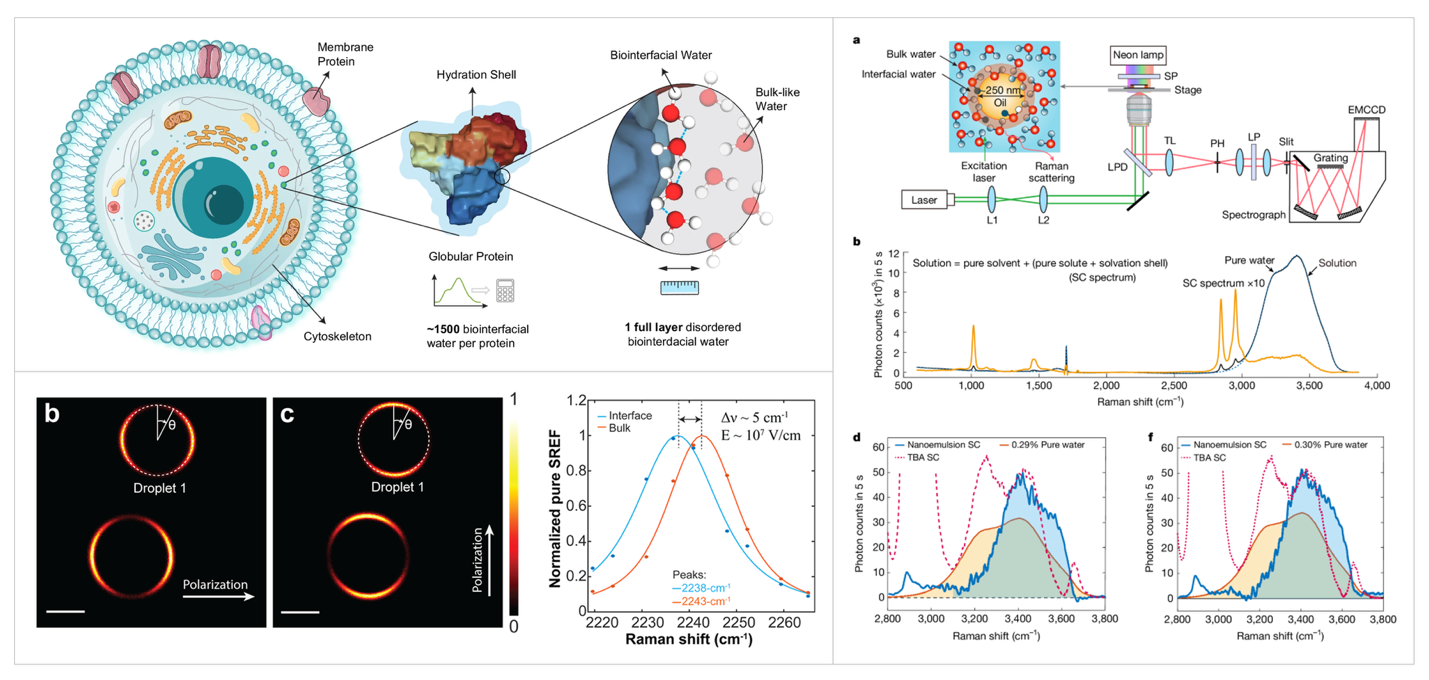
Composite illustration and Raman measurements of biointerfacial water, aqueous microdroplet electric fields, and oil-water interfaces

Water at interfaces can behave remarkably differently from bulk water, yet its molecular structure and electrostatic properties are notoriously difficult to probe. We develop in-solution, interface-selective vibrational spectroscopic methods to study these properties in complex systems. In living cells, we identified a thin layer of structurally disordered water surrounding intracellular proteins. Using vibrational Stark probes, we directly measured strong electric fields at aqueous microdroplet interfaces. Raman-MCR spectroscopy further revealed disrupted hydrogen bonding, red-shifted dangling OH groups, and strong electric fields at oil-water interfaces.

  • X. Lang, L. Shi, Z. Zhao and W. Min. “Probing the structure of water in individual living cells,” Nature Communications 15, 5271 (2024).
  • H. Xiong, J. K. Lee, R. N. Zare and W. Min. “Strong Electric Field Observed at the Interface of Aqueous Microdroplets,” J. Phys. Chem. Lett. 11, 7423–7428 (2020).
  • L. Shi, R. A. LaCour, N. Qian, J. P. Heindel, X. Lang, R. Zhao, T. Head-Gordon and W. Min. “Water structure and electric fields at the interface of oil droplets,” Nature 640, 87–93 (2025).
Theory of Interfacial Chemistry

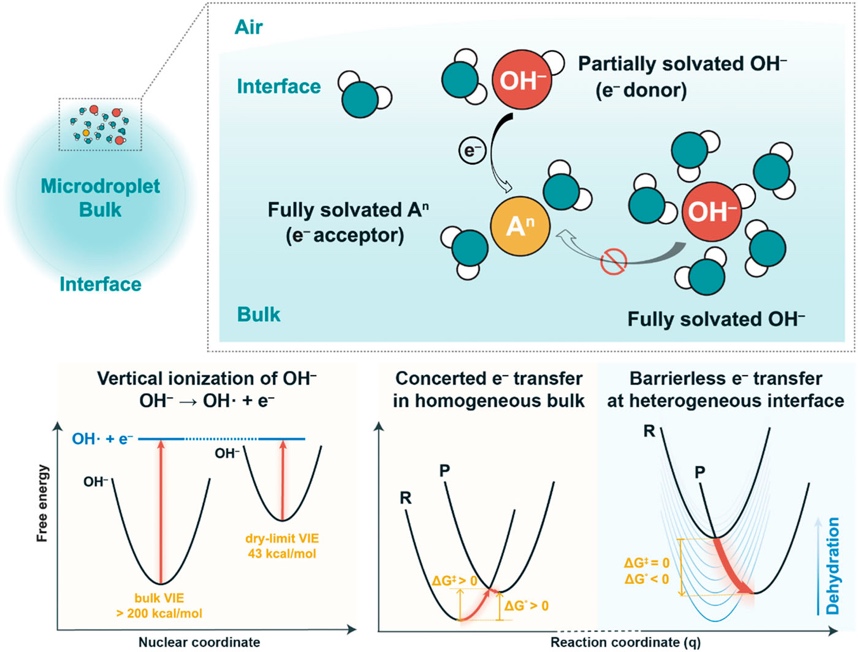
Quantum tunneling model for electron transfer by partially solvated hydroxide at a water interface

Water microdroplets and other interfacial systems can spontaneously drive redox reactions that are thermodynamically and kinetically unfavorable in bulk solution. To understand this unusual reactivity, we develop a theoretical framework, Quantum Tunneling on Water, across Part I, Part II, and Part III of this series. In particular, we extend Marcus electron-transfer theory to heterogeneous water interfaces. Within this picture, the interface can prepare and gate a population of partially desolvated OH− whose electrons couple to nearby molecular acceptors and undergo concerted quantum tunneling. This framework provides a robust explanation and prediction for the rich redox chemistry at water interfaces.

  • C. Zhuang, N. Qian and W. Min. “Quantum tunneling on water. I. General framework for microdroplet redox chemistry,” J. Chem. Phys. 164, 224709 (2026).